




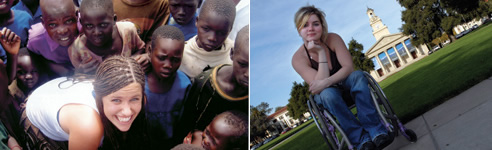
For more information about the Invisible Children cause and how to get involved or contribute, contact Emily Sernaker at Emily_sernaker@redlands.edu.
For more information on the Cody Unser First Step Foundation, visit www.codysfirststep.org or call (505) 890-0086.
Unser has been to Washington, D.C. more than five times for her cause, including a trip in May 2006 to speak at a rally sponsored by the Christopher Reeve Foundation and United 2 Fight Paralysis. She has worked with the Christopher Reeve Foundation closely over the past few years, visiting key congressmen in hopes of convincing them to pass embryonic stem cell research and funding measures.
“I go in from the patient perspective,” she explained. “My goal is to have the politicians see how important this is, not just to me but to other people in similar situations.”
Unser has learned several political lessons the hard way, and said her experiences have taught her to be patient. But she also rejoices in small political victories.
“I’ve learned not to let my emotions get the best of me,” she said. “I see now that no matter how passionate you are or how intelligent your argument is, there are still brick walls—people that are against this. But I know that I need to find out why they are against it and address those concerns. It’s important to keep pushing through the walls.”
Unser, who is from Albuquerque, said she chose to attend the University of Redlands because she recognized it as a place where her passion and ideas would be heard.
“I knew this would be a place that would embrace the foundation and see the value in it,” she said.
The Johnston Center for Integrative Studies student is majoring in biopolitics, a degree she crafted to combine medical knowledge with strategic political communication. She said her goal is to get her message out more effectively.
“Health affects everyone’s quality of life,” she said. “There are so many issues with insurance, research funding, and other things. There’s a lot to learn.”
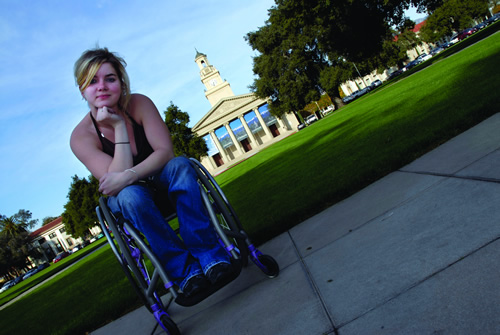
Unser said she has found Redlands’ students, faculty and staff to be supportive. Some of her classes have been relocated to make them more accessible, she said, and friends have been seen assisting her around campus when necessary.
“People are very open to talking to me about my experiences,” she said. “It’s been a good place for me.”
Unser has read research that shows patients with neurological diseases like hers tend to grapple with depression throughout their lives. But she said she experiences few emotional valleys.
“I never really get depressed,” she said. “This foundation helps to keep me going. Knowing that I can do something to help other people is inspiring to me. It keeps away any bad thoughts, I think.”
“Sometimes I think about what my life might be like today if this (disease) hadn’t happened to me. It blows me away, because I can’t even imagine,” she said. “I would be a very different person, I think. I can see why things might happen the way they do at times.”