Grasping the ladder with my left hand, I hooked the bucket of paint on as high a rung as I could reach. The sun beat on my back; even in February, you can feel that the Louisiana rays hit you straighter than in California. I looked up at the bright yellow siding before me and saw I needed to fill in some spots a few feet higher. I told myself to look out, not down. As far as I could see from that 20-foot vantage point, clear to the flat horizon somewhere near the Mississippi River, stretched street after street of destroyed houses. “I have to do this,” I said to myself. “This is my job now.” I took a deep, steadying breath and climbed one rung higher, feeling the ladder tremble and my 59-year-old hip joints ache. I reminded myself that my new pals Ron Troupe ’64 and Steve Dyerly, a parent of a Redlands grad, had helped me dig the ladder cleats deeply into the New Orleans sand. The ladder would hold me. I re-hooked the paint bucket gingerly. Trembling, I dipped and wiped the brush, reached it out as far as I dared towards the eaves, and smoothed it across the siding like lemon icing on a cake.
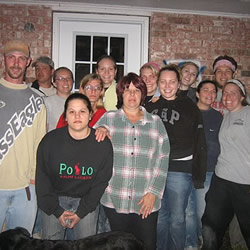
It was the final workday of a life-changing week, the University of Redlands alumni trip to New Orleans last February. Forty-nine UR friends, staff and alums had connected up with New Orleans Area Habitat for Humanity to help build houses in that hurricane-ravaged city—the first-ever alumni social service trip.
Although I’d been involved with many nonprofits over the years, my activism until now had taken a more cerebral, sedentary form: speaking, writing letters, attending workshops. Why on earth, I asked myself with some apprehension as the plane dipped over the Mississippi Delta’s vast, sandy patchwork of waterways, had I waited until I was nearly 60 to start volunteering my physical labor?
Camp Hope is a gutted former elementary school in St. Bernard Parish, one of Greater New Orleans’ three devastated parishes (that quaint word for county is one relict of 18th-century French Catholic rule). Like every single building in the parish, the school suffered major structural damage from two weeks’ submersion in filthy water—but crews of AmeriCorps kids had turned it into a workable, if primitive, living space.
Camp Hope was part summer camp and part dorm—very apt for an alumni gathering! We ate grits and biscuits with gravy in a barn-like central room, once the school’s auditorium. At the long dining tables we rubbed shoulders and swapped stories with college kids and retirees from Massachusetts to Seattle (there weren’t too many working-age folks).
Memories of Redlands dorm life came flooding back in our cavernous, gender-segregated “bedrooms”—former classrooms, completely stripped of insulation, with bare cement floors and sheets for curtains. Some fifteen cots lined the walls of our room. We spanned three generations of UR women, including several tough grandmas.
Although most of us were strangers, we had more than Och Tamale in common now: We had all been suddenly pulled out of our daily routines and comfort zones, and thrust into an utterly new environment. Immediate, physical necessity bonded us quickly. We helped each other scrounge unused mattresses for insulation from the unexpectedly frigid nights. We shared meds and tended the sore and ailing.
To give context to the Habitat work to come, several of us took bus tours first. Mine was the Hurricane Katrina Tour, a riveting, visually appalling and emotionally wrenching three hours witnessing the devastation of Greater New Orleans. I tried to digest the kaleidoscopic impressions that passed by: thousands of empty homes, in various stages of ruin; holes in roofs where people had sought escape; the spray-painted X’s indicating if the rescuers found anyone, alive or dead; gaping breaches in levees; eerily empty streets.
Our guide spoke wistfully about how beautiful this or that neighborhood had been for generations. That beauty was hard to imagine, except in the French Quarter, which had been largely spared (alas, I had never visited New Orleans pre-Katrina). Katrina knew no racial boundaries, but the levee breaks were the worst and recovery has been slowest for the majority black population. Comparisons popped into my mind: Cities destroyed in WWII. Scenes of third-world squalor in National Geographic. Iraq without the car bombs. I knew it would be bad, but I never expected it to be this bad, as far as the eye could see for miles and miles, 18 months after the storm.
I joined the carpool early the next morning for my first day of Habitat work—a little anxious, but fortified with caffeine and adrenalin. We worked in a black district called New Orleans East. Flooding throughout this immense area had been catastrophic, thanks to a deadly combination of storm surge and levee breaks. As in many neighborhoods, the houses around our worksite were mostly structurally intact. But every home (except those that Habitat had built high on cinder blocks pre-Katrina) had been rendered uninhabitable—and often un-rehab-able—by weeks of stewing in a toxic, putrid bath up to ten feet deep. Most homes had been mucked out, but if you came close to a door, the moldy smell was still overpowering.
Boats perched incongruously in yards where they’d washed up a year and a half before. Rusted-out cars sat everywhere. In a few cases the ruined detritus of indoor life—refrigerators, couches, TVs—still rotted outside. But dozens of vividly-hued new houses in different stages of completion marked our neighborhood as one of the lucky ones targeted by Habitat. The vibrant yellows, oranges, blues, purples and greens—colors all picked out by the future homeowners—were visual beacons of hope amid acres of mud-toned houses and trash heaps
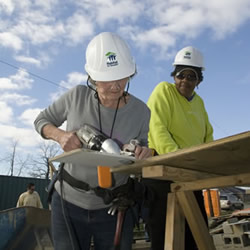
At the end of that first day of caulking and painting, I was exhausted in that exhilarating, physical way most of us rarely feel as adults. And the fruits of our labor were so immediately visible, unlike in most of our normal lives. We had the individual triumphs: “I can nail up siding that’s straight!” or “I can climb a ladder higher than my husband!”—and the collective triumph: “We are building a strong, beautiful house together!” Those primitive showers back at Camp Hope were utterly heavenly. Who cared about the cold cement and torn plastic curtains? The water was hot and plentiful.
Personally, this trip did a lot more than teach me to soar on a ladder, although that was cool. I got to know a beautiful, exotic part of my country; I got to help people in desperate need; I tested my own physical limits (I’d been babying myself!); and—the most unexpected payoff—I got reacquainted with my alma mater and excited by the social service ethic afoot there today.
In 1970 we were so righteous marching down State St. in Redlands, protesting the Vietnam War. But let’s face it, it’s a lot tougher to muck out stinking New Orleans houses—as the UR football team and other current UR students have done on several trips of their own. Another promising sign of the times: in New Orleans I found myself sweating and laughing next to university staffers and board members (the impetus for this trip, in fact, came from members of the alumni board).
We New Orleans UR sojourners developed a joking and easy camaraderie, which helped us get through our shock, sadness and rage over the post-flood reality. We’re already emailing about our first reunion trip next spring (check the Web site for details). We hope we have started a tradition. We sure could use more people. Trust me, if I could do it, almost anyone can!